
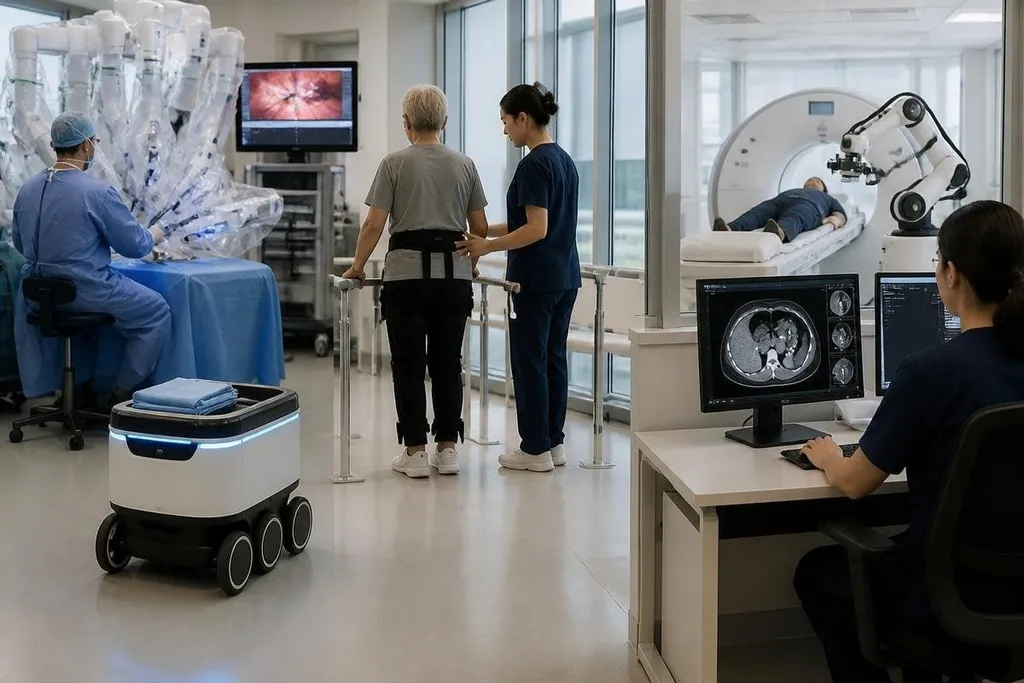
A healthcare robot can move a tray, guide a surgeon, or help a patient repeat a therapy exercise. The hard part is proving that the robot improves care without adding risk, delay, or work for staff.
- Surgery: look for patient outcomes, not a polished operating-room video.
- Rehabilitation: check whether patients can repeat the task safely over time.
- Hospital work: measure handoffs, cleaning, charging, and staff time.
The supplied brief contains no evidence pack, so this article does not attach claims to named products, hospitals, dates, prices, or trial results. It sets out the evidence that healthcare robots need to earn attention.
Surgical robots need patient results
Surgical robots give doctors steady tool movement, small instrument control, and a view inside the body. Those features matter only when they improve a measured result, such as fewer complications, shorter hospital stays, or faster recovery.
A useful report should name the procedure, the number of patients, the comparison group, and the period covered. It should also explain who controlled the robot. A system guided fully by a surgeon raises different questions from one that makes movement choices on its own.
Force sensing matters when a tool touches tissue. The system measures contact and can warn the operator when pressure rises. That does not prove safer surgery. The report still needs patient data and a clear record of errors, conversions to manual surgery, and device faults.
Rehabilitation robots need repeatable work
Rehabilitation systems help patients repeat movements with a leg, arm, or hand. Repetition is useful when the robot keeps the task within a safe range and records how the patient changes over time.
The useful figures include session length, number of sessions, movement range, assistance level, and dropout rate. A robot that guides a patient through one successful session has shown less than a system used across a full treatment plan.
Clinicians also need control over the task. They may need to change the speed, limit joint movement, or stop assistance when pain appears. A machine that takes too long to set up can lose its value, even if its motors and sensors work well.
Hospital robots need safe handoffs
Transport robots can move medicines, samples, meals, or waste through a hospital. Their work crosses doors, lifts, staff areas, and patient spaces, so the handoff matters as much as the driving.
A report should show who loads the item, who receives it, how identity is checked, and what happens when a route is blocked. It should also cover cleaning between tasks, battery charging, lift access, and the time staff spend fixing failed deliveries.
This is where small operating details decide whether a trial helps. A robot may travel without a person beside it, yet still need staff at both ends of every trip. The transport time has to be measured with those human steps included.
For industry readers comparing care settings, reported deployments matter more than a clean demo. Robot24.com healthcare robotics reporting can tie a claim to a named machine, site, task, and result before the article turns to diagnostic robots.
Diagnostic robots need a clear boundary
Robots used with imaging, laboratory work, or medication handling must show where the machine stops and a trained person takes over. That boundary should appear in the instructions, the test record, and the safety review.
A system may sort samples, position a sensor, or move a patient into place. Each task has a different failure cost. A missed barcode, a wrong sample, or a delayed alert can affect care long after the robot finishes its movement.
The proof should include the error rate, the review process, and the conditions used in testing. Results from a quiet test room do not describe a crowded ward with interruptions, new staff, and changing routes.
A practical watchlist
Use these checks before calling a healthcare robot a breakthrough:
- Name the task: state the exact job, the person who controls it, and the point where manual work begins.
- Read the comparison: check what the robot was measured against, such as a current tool, a staff process, or another device.
- Check the setting: confirm that testing took place in the care environment where the robot will work.
- Count the human steps: include loading, setup, cleaning, charging, monitoring, and fault recovery.
- Find the open result: look for missing patient data, short trial periods, limited users, or untested failure cases.
I’d wait for that evidence before calling any healthcare robot a breakthrough. The systems worth watching next are the ones that publish task results, safety limits, and staff workload alongside the demonstration.